Rebuilding the University
The university died because we forget what universities were. Where they came from, what purpose they served, the intellectual traditions they were built upon. Free tuition and other poorly conceived projects will never improve the situation. Only history can.
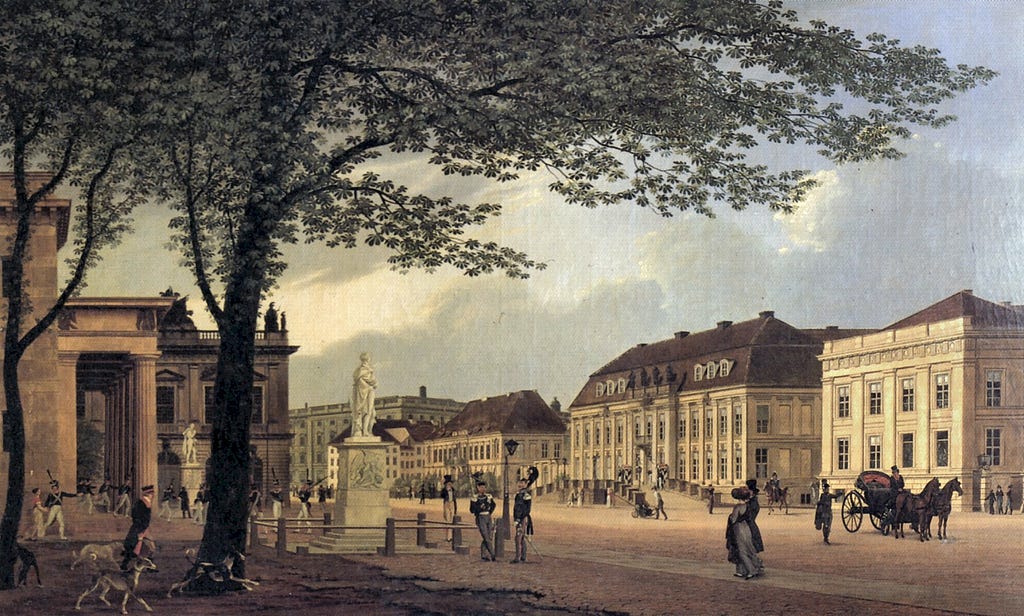
Late 19th century philosophy, especially of the German variety, is conventionally understood as being something of a nihilistic nadir of of thought following the devastating collapse of Hegelianism and Prussian Reformism. It’s the era of Weltschmerz, Nietzsche, and increasing unrest and displacement in the wake of the Industrial Revolution. consequently the philosophy of the later 19th century is usually understood as representing a fundamental break with earlier traditions of the Enlightenment.
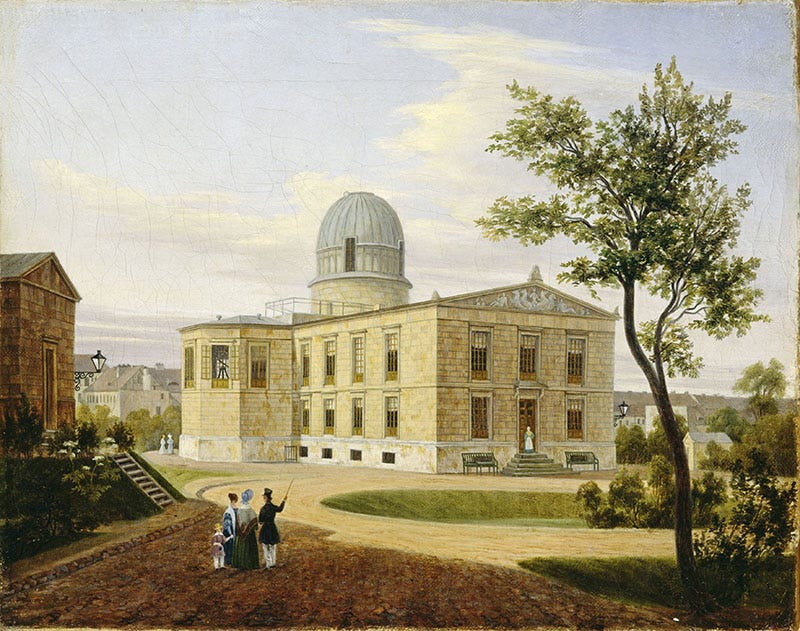
Perception of the German scene of that period is typically dominated in established narratives of intellectual history by a handful of iconoclastic thinkers who became, only during the 20th century, so central to the major ideological projects of the post-liberal, post-industrial age. Despite the fact that many of Marx’s works weren’t published during his lifetime, but only became widely available through scholarship like that of the Marx–Engels Institute after 1919.
Frederick Beiser has, as usual, done the most to dispel this distortion in his After Hegel: German Philosophy, 1840–1900. Here he outlines the investigations he’s pursued since his 2011 reconstruction of the emergence of historicism, The German Historicist Tradition. Beiser challenges the common consensus regarding German philosophy after 1848, noting how the standard narratives have typically neglected certain subjects, which he views as those most central within contemporary contexts.
Beiser specifically identifies the ascension of neo-Kantianism, historicism, and the beginnings of modern formal logic as areas which have received little attention from intellectual and philosophical historians. Furthermore, he emphasizes how during the materialism and pessimism controversies, Marx and Nietzsche were not the central participants or victors. Rather it’s actually Friedrich Lang, for instance, who Beiser views as having resolved the materialism controversy, not Marx or any other contemporary socialist theorist.
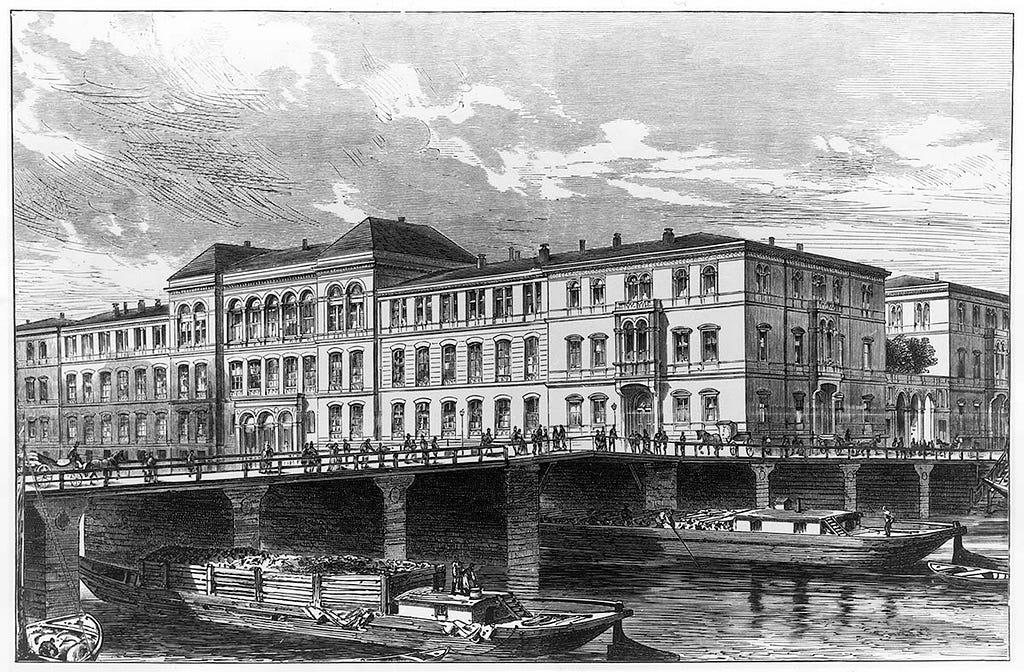
It’s to one of Heidegger’s students, Karl Löwith, that Beiser traces this narrative, specifically his 1941 book From Hegel to Nietzsche: The Revolutionary Break in 19th Century Thought. Beiser writes:
“According to one narrative, whose roots we can trace back to Karl Löwith’s seminal Von Hegel zu Nietzsche, German philosophy in the nineteenth century is essentially the story about the revolutionary transformation of Hegel’s philosophy by the young Hegelians, Marx, Kierkegaard, and Nietzsche. This transformation gave rise to two major philosophical traditions, Marxism and existentialism, which are seen as the main intellectual legacy of nineteenth-century philosophy. Though rarely read today, Löwith’s narrative has been profoundly influential. It has been the chief source for many popular histories of philosophy in the Anglophone world, and it has formed the syllabi for countless courses on nineteenth-century philosophy in Anglophone universities.”
Contrary to this narrative, and following Beiser, further investigation strongly suggests not a dissolution, or collapse of philosophy at this time, but an enormous groundswell of possibilities and ideas. The rise of neo-Kantianism, for example, coincided with professional standardization in the academy whereby the model of the University of Berlin fully replaced that of the medieval university, as exemplified by the University of Bologna and its division into the four faculties. Students first learned the trivium and attended the faculty of arts as the prerequisite for study at one of the higher faculties: theology, law, or medicine.
During the nineteenth century a committee of historians revised the date of the founding of the University of Bologna from the year 1158, when Holy Roman Emperor Frederick I Barbarossa granted the university its charter, to 1088, “when masters of Grammar, Rhetoric and Logic began to devote themselves to the law.”
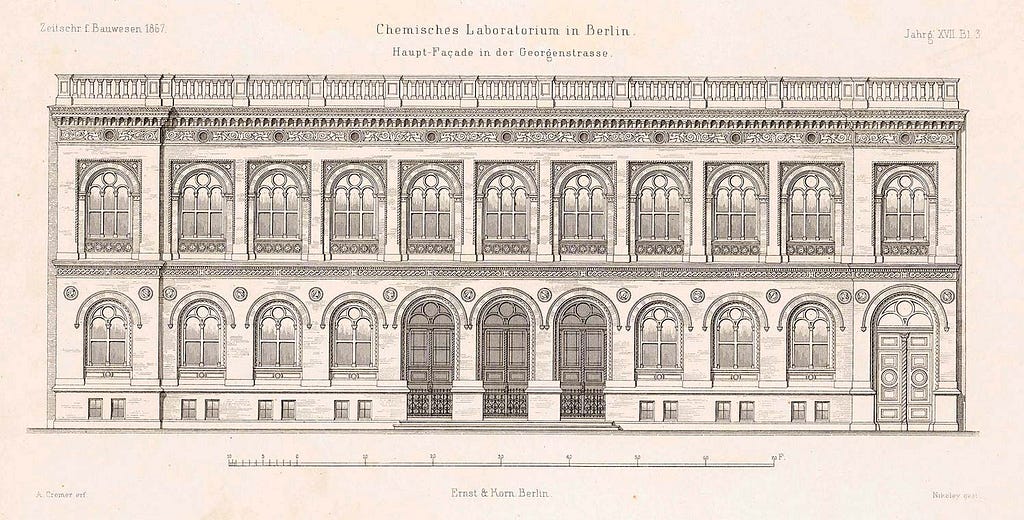
In contrast, it was as a central component of the Prussian Reform Movement that the University of Berlin had been established under the reign of Frederick William III based on a plan developed by Wilhelm von Humboldt, Johann Gottlieb Fichte, Friedrich Schleiermacher, and Friedrich Carl von Savigny, who were appointed the first chairs of the philosophy, theology, and law departments respectfully.
It’s after this model the modern academy is really built, and directly so. This is not merely a conjectural observation of trends in institutional design, but is substantively confirmed in the University of Chicago’s own published sourcebook, The Rise of the Research University, in which editors Louis Menand, Paul Reitter, and Chad Wellmon write:
“The nineteenth-century German university, both real and imagined, was especially important for the first American research universities. The key reformers of American higher education in the second half of the nineteenth century — Daniel Coit Gilman at Johns Hopkins, Charles William Eliot at Harvard, William Rainey Harper at Chicago, and Henry Tappan at Michigan, among others — either studied in Germany or cited the German university as a model. When Johns Hopkins opened in 1876, nearly the entire faculty had studied in Germany.”
They go on to name Humboldt’s “On the Internal Structure of the University in Berlin and Its Relationship to Other Organizations” (1810) as the ur-text of the modern university, observing how “the concepts to which many German and American universities still appeal today — the unity of teaching and research, academic freedom, the open-ended character of research — echo some of their earliest formulations in the work of writers such as Wilhelm von Humboldt, Johann G. Fichte, Friedrich Schleiermacher, and Friedrich W. J. Schelling.”
Further evidence is collected, with British school inspector Matthew Arnold’s Schools and Universities on the Continent (1868) attesting: “Such is the system of the German universities. Lehrfreiheit and Lernfreiheit, liberty for the teacher and the learner; and Wissenschaft, science, knowledge systematically pursued and prized in and for itself, are the fundamental ideas of that system. It is in science that we need to borrow from the German universities. The French have no liberty, and the English universities have no science; the German universities have both.”
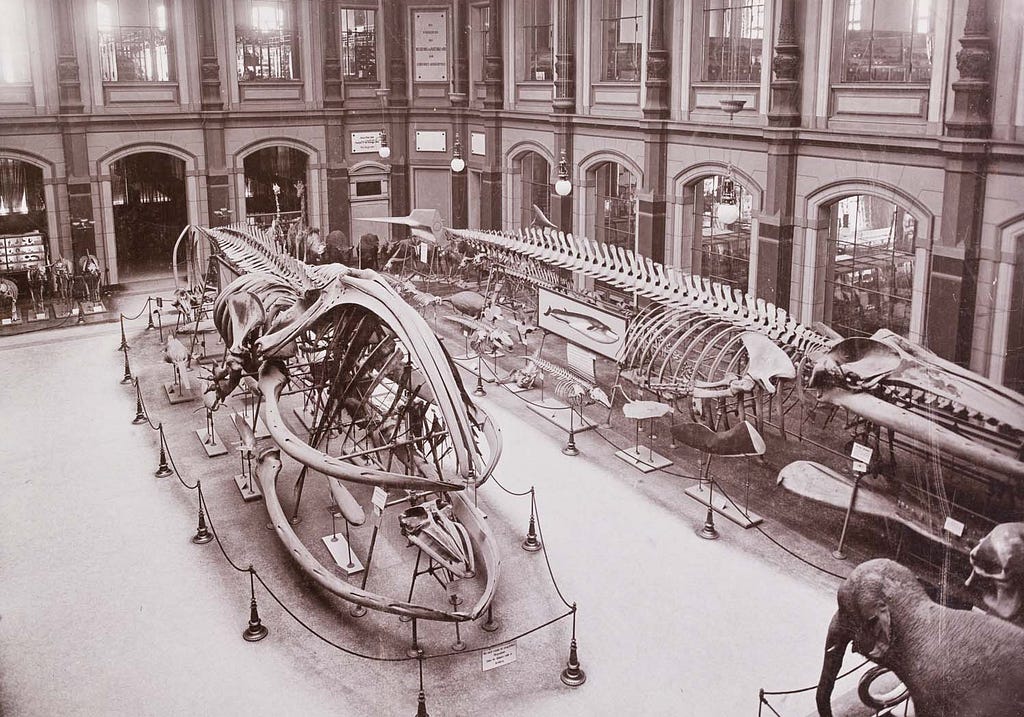
Thus the medieval university was supplanted. Boethius’ seven liberal arts gave way to Weltanschauung, the transcendental psychology of doctrine of intersubjective development of Fichte’s science of knowledge, the developmental program of Bildung of Goethe’s Wilhelm Meister, the historicism which Humboldt and Hegel alike took from Herder, the linguistics and philosophy of language of Humboldt. The hermeneutics of Schleiermacher and the rigorous post-Kantian approach to meaning it provides to German Romantic literary theory.
Specifically it was these contemporary works which form the primary source of ideas which the University of Berlin and those modeled after it draw upon:
- Fichte’s inaugural series of lectures at the University of Jena, given in 1794, On Vocation of the Scholar.
- Schleiermacher’s lectures on Hermeneutics at the University of Halle, first given in 1805.
- Schleiermacher’s On Religion: Speeches to Its Cultured Despisers, from 1799
- Schleiermacher’s published proposal for the University of Berlin, from 1809: Occasional Thoughts on Universities in a German Spirit
- Humboldt’s Limits of State Action. Specifically, Chapter VI: National education. Which was published as a standalone essay
These works, though, are only foam floating on the surface of the magnificent reservoir of German culture of the period. Each of them is but a fragment. None of them are isolated from the world. To illustrate, one must only consider how Schleiermacher, from 1797 to 1799, lived with Fredrich Schlegel and worked extensively in collaboration with him and other members of the early German Romantic movement on half a dozen other projects. Schleiermacher was one of the contributors, along with Novalis, as was August Schlegel to Friedrich’s journal, Athenaeum. Here hundreds of ideas, sketches, critical observations, etc., laid out as a sprawling collection of aphoristic fragments, serve as the seeds for the entire modern garden of literary theory, criticism, translation theory, hermeneutics, theory of the novel, on and on.
During this same period Schleiermacher was compelled by F. Schlegel to produce a modern German edition of Plato following the precepts of their theories on language and meaning, despite Schleiermacher’s own self-deprecating prediction that: “In fifty years someone else will probably do it better.” In one paper on Schleiermacher’s scholarly methodology, Julia Lamm summarizes the modern consensus: “Schleiermacher’s prediction regarding his own translation of Plato, if sincere, could not have been more wrong. Almost two hundred years later, his translation not only dominates sales of paperback editions of Plato in Germany, but also remains the authoritative translation for scholars.”
These projects and approaches and methods and ways of thinking and seeing are not exclusive to even this setting, but expand outward at every level through the entire totality of contemporary thought. We find in much of Humboldt and Schleiermacher’s work only a continued development of what Herder had started to say two or three decades previously. And likewise, the historicism of Herder which so influenced Humboldt, likewise exerted a decisive influence on Hegel’s conception of history. Despite it being so commonplace an assertion that Marx’s historical dialectic is taken up from Hegel’s conception of history, never do those who remind us of the fact proceed any further to actually understand that historical conception in its totality, as rooted in Herder and developed in parallel to Hegel by Humboldt and many others.
In exactly the same way, as much as people flap their lips and talk about Marx and Hegel and the dialectic, who do you ever find among them capable of going any further? To a proper understanding of the matter, which assimilates the fact that Hegel and Absolute Idealism were profoundly shaped by Schleiermacher’s Plato translations, which at just that historical moment, revived and transformed German Idealism’s sense of the place of dialectic in contradiction the one Kant had given it.
We can discuss these matters endlessly, and trace these influences, and expound upon them, yet my purpose is only demonstrative, in showing the complex network of ideas and connections stretching from the 1780s and 1790s, well into the early 20th century and the origins of clinical psychology. So much scholarship written by academics today investigating the histories and fundamental ideas of their own disciplines shows a complete lack of awareness as to the prehistorical and proto-historical epochs underlying them. One could almost say even that work from the 1760s by Kant and Herder, and from the 1790s and 1800s by Humboldt etc., functions as something of a disciplinary unconscious for modern anthropology or psychology. Those deeper origins stand outside the bounds of their own methodological horizons.
For a psychologist to study Wundt but never penetrate deeply enough to reach Herder is for him to be condemned to permanent incomprehension of the essence and identity of his field. Likewise nothing in this early history of psychology or sociology can be taken in isolation of the prevailing atmosphere of neo-Kantianism.
As we’ve seen, the universities in which these disciplines were incubated represented an entirely new, reformed model of the institution, one which completely overturned the ancient stone foundation Boethius, Capela, and Cassiodorous had laid a thousand years prior. The new foundation was Weltanschauung. Bildung. Kritik. Volk. Wissenschaft. Dialektik. These terms are not merely arbitrary signs. Their usage in the year 1900 is not free floating, independent, disconnected, ungrounded from their usage a century earlier. Together they comprise the conceptual toolkit developed and used in German philosophy and literature between 1770 and 1815. Every participant thinker who engaged in the debates and projects of that time, no matter big or small, contributed to the development of these, and in turn, in the very act of using them, participated in the construction of their era’s entire world.
That Freud and Jung spar over Weltanschauung in their lectures; that Dilthey treats Weltanschauung as the actual object of historicist methodology; that Mannheim synthesizes Weltanschauung with the Marxist theory of Ideology; that Husserl and Heidegger split it between themselves into Lebenswelt and Weltbild as they go their separate ways… this must all be understood in context of the entire history of the development they undergo.
Here we’re dealing with not with the ancient canons of law, and theology, and medicine, but with cutting-edge, post-critical precision instruments designed in conformance to the specifications outlined in the transcendental philosophies of science and knowledge figures like Kant and Fichte spent decades honing. This, I believe, is a very important point to emphasize in relation to the frequent appearance such concepts make in the writing of later thinkers associated with the origins of psychology etc.
Upon the model of the new research university in Berlin then, by the end of the 19th century a new kind of professional research scholar had emerged, one who was tasked with harvesting the bountiful crop his 18th century forbearers had planted in advance. These were not iconoclastic Nietzschean hysterical supermen, so much as they represented nothing less than a highly disciplined army of professionals. An army of investigators equipped with a neo-Kantian philosophy of science, trained and organized not within the four ancient departments of found at the University of Bologna, but in the post-Kantian framework of transcendental Bildung articulated by Fichte and Humboldt.
This design is found articulated best by none other than Kant himself, in his essay “On the Contest of the Faculties,” where he envisions for his critical philosophy of knowledge and science a role within the university of the next century as the institutional adjudicator of industrialized knowledge production. In this way his neo-Lebnizian technics of knowledge would be implemented, functioning algorithmically to combinatorically generate science infinitely until everything was finally known.